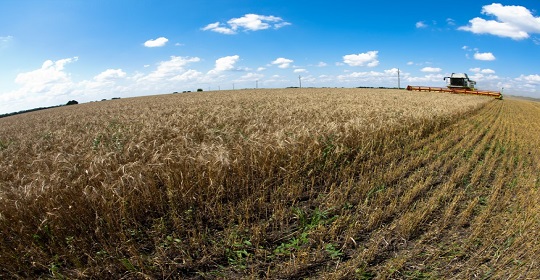
American analysts have adjusted their expectations for Russian grain supply volumes to the global market this season.
According to a recent report from the US Department of Agriculture, Russia’s wheat export forecast has been revised upward by 1 million tons, currently reaching 44.5 million tons. This decision is due to the impressive shipment volumes recorded in March.
As for Russia’s main competitor in foreign markets—the European Union—its export forecast has been maintained at the March level, at 30.5 million tons.
At the same time, Russia’s future harvest estimate has also been revised.
Instead of the previous 89.5 million tons, the US Department of Agriculture now expects 90.3 million tons. It’s worth noting that these figures do not include Crimea and the new territories.
Nevertheless, if the current forecast is realized, compared to last year’s results, it would mean a decline in wheat production: Russian statistical agencies recorded a net wheat harvest of 91 million tons last year (also excluding the new regions). The feed grain segment also received attention.
Russia’s export estimate was raised by 300,000 tons, to 7.63 million tons. This was due to the gross harvest forecast being raised from 39.05 million tons to 39.35 million tons, primarily due to corn.
The USDA’s global estimates also changed.
In particular, it is noteworthy that the global wheat harvest was increased from 842 million tons to 844 million tons. At the same time, analysts lowered their forecasts for grain shipments from Australia and Brazil, but raised them for exports from Russia and Kazakhstan.
An important point is that global wheat consumption is growing. Last year, it amounted to 810 million tons.
The US Department of Agriculture has now lowered its forecast from 825 million tonnes to 820 million, but we still see that the new figure is significantly higher than last year’s.
Finally, global wheat stocks last season were 259 million tonnes, and the USDA has now raised its forecast from 277 million to 283 million. Experts note that the volume of available stocks has risen to its highest level in five years.
Overall, this suggests that supply on the global market currently outweighs demand, which, in turn, could mean that prices will remain relatively low for some time to come, a significant challenge for food producers.