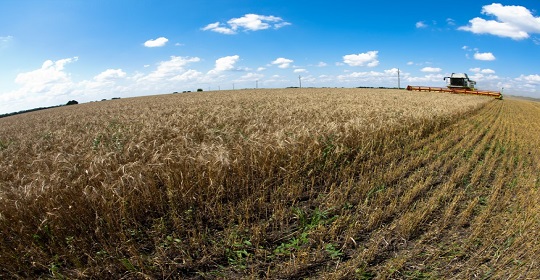
As experts note, the issue of grain transportation remains one of the most pressing issues for Russian agricultural exports.
The vast distances typical of Russia, as well as the dispersed nature of production facilities, mean that delivering grain from one region of the country to another—for example, from a field to a port for export—is a complex task in almost all cases.
And this is a significant growth area for the entire Russian agribusiness.
As Minister of Agriculture Oksana Lut stated at the All-Russian Grain Forum, the ministry is currently focused on making logistics more efficient for both farmers and exporters.
The minister emphasized that she considers the transition to multimodal transportation, which combines road, rail, river, and sea transport, to be a priority for logistics development in Russia today.
This approach, she believes, significantly reduces product delivery costs and is overall more efficient.
Analysts currently believe that the situation could improve significantly after the commissioning of two hydroelectric power plants in the foreseeable future—the Bagaevsky hydroelectric power plant in the Rostov Region and the Gorodetsky hydroelectric power plant in the Nizhny Novgorod Region.
These facilities are expected to provide a new impetus to the development of inland waterways, which could significantly change the current transportation situation.
It’s worth noting that a special situation has developed in Siberia, where gross grain harvests are constantly growing, but transporting grain from there is extremely problematic.
It’s reached the point where the cost of transportation is often comparable to the price of the grain itself. This effectively means that grain production there is economically unprofitable.
Naturally, this state of affairs has an extremely negative impact on agricultural producers’ motivation to increase and even maintain production volumes.
To address this problem, the Ministry of Transport is already offering discounts on shipments from this region. However, according to Luth, additional measures are needed, and the ministry expects more active support from Russian Railways and the Ministry of Transport.
Meanwhile, transportation benefits from Crimea are under threat—they could be revoked next year, which would also be extremely detrimental to agricultural development in the region.
To prevent this, the minister promised to make efforts to maintain existing preferences.