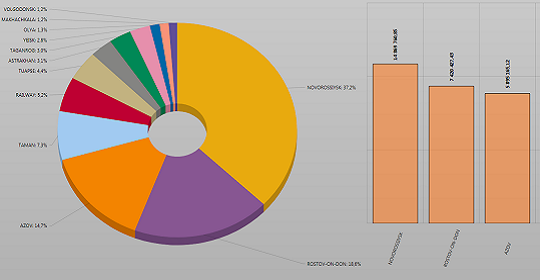
Russian wheat exports in September could fall to their lowest level since 2010.
Analysts forecast shipments of 1.6 to 2 million tons, almost 2.5 times less than last year’s figures.
Experts identify the key factors that led to such a sharp slowdown in shipments at the start of the 2026/27 season.
Paralysis of Southern Logistics and Route Shifts
The main reason for the collapse in export figures was the protracted crisis in port infrastructure:
Azov Basin: navigation completely halted in mid-July;
Black Sea Hub: the ports of KSK and NZT have been seriously disrupted since mid-August;
Novorossiysk and Tuapse are operating at limited capacity, loading grain directly onto small vessels, bypassing elevators.
Traders are hastily redirecting flows to alternative destinations. According to market participants, demand for rail freight to Russia’s Baltic ports and terminals has increased sharply.
However, the capacity of the northwest corridor is inferior to the southern one – no more than 0.5 million tons pass through it per month, which is less than 10% of the usual southern transshipment volumes.
Because of this, the vast majority of current shipments are handled by rail.
Price Gap: Global Highs vs. Domestic Collapse
The domestic logistics collapse has triggered a paradoxical situation on the global market:
Global quotes: Futures on exchanges have reached new three-year highs.
The situation is fueled by the escalating conflict in Iran, which is pushing up oil prices.
Global importers are sounding the alarm: Tunisia purchased wheat at $308 per ton during the August tenders ($23 higher than the previous month), and Turkey urgently postponed the start of grain sales from state reserves to the domestic market from October to September 1.
Russian Domestic Market: Due to the inability to export grain, domestic prices in Russia have fallen by more than 40% year-on-year.
Against this backdrop, the Ministry of Agriculture has begun discussing the possibility of temporarily waiving the export duty to zero to salvage agricultural producers’ profitability.
Otherwise, there is a real risk of a massive reduction in the area sown for next year’s harvest.
Forecasts until the end of the season
Expert centers are unanimously downgrading their annual guidance. Analysts have reduced their wheat export forecast for the 2026/27 season by 3.2 million tons, to 41.4 million tons.
Total exports for the first three months of the season will amount to approximately 5.6 million tons, compared to 11.3 million tons for the same period last year.
The situation in the Azov-Black Sea basin is not expected to normalize in the coming weeks.
A partial recovery in shipments is possible only in late autumn. Until then, low shipment rates from Russia will continue to keep global prices high, simultaneously increasing price pressure on domestic farmers.